

|
Building IV,II,5 was set against the outer north-west wall of the Baths of the Lighthouse (IV,II,1). It was excavated in 1940. There are a few remains of Hadrianic opus mixtum. Most masonry belongs to the reign of Antoninus Pius or Marcus Aurelius (opus latericium; a coin of Marcus Aurelius from 177-178 AD was found). The only entrance was at the north end, from the paved square of the House of Hercules (IV,II,3). The rooms of the building are on either side of a corridor (5). The ground floor may have been an apartment. There are two small, relatively dark rooms on the south-east side (6, 7). These may have been bedrooms (cubicula). On the north-west side are four rooms, along a public alley connecting the paved square and an unpaved square in the south part of the block. The two southern rooms along the alley (1, 2) had wide entrances in the facade (later these were narrowed, and then blocked). In the facade of the two northern rooms windows have been preserved. At the south end of the corridor is a courtyard (4). In room 7 remains of a painting can be seen on the original, Hadrianic back wall. On a white background are the upper part of a yellow aedicula, a yellow garland, and a red rectangle with one curved side. On the later back wall are some scant remains: a wide red band on a white background. Well-preserved paintings were found on three walls of room 6. These have been taken to the storage rooms. On a white background are many red, yellow and green aediculae and panels, in two horizontal zones. The aediculae are connected by garlands. In the panels are griffins, swans, and a mask. The animals coud be a reference to Apollo. These paintings have been assigned to the late-Antonine period. At an unknown point in time the north end of the building was modified extensively: an elaborate stairwell was added, and a huge cistern serving the baths (10). The north-east entrance of corridor 5 was now blocked by the large room 10. In room 4 a most curious structure was added. It consists of two small rooms, the northern one very low and with a sloping ceiling. A new entrance was hacked out in the south-west wall. From that time onwards the building could only be reached through openings in the south-west part, or even (because these rough openings may be quite late) from the first floor. In room 6 a cippus with a dedication to Isis and the Genius of the Apartment (Genius Cenaculi) was found, by Claudius Pompeius Rusticus Diocles, miles frumentarius from the third Gallic legion. The frumentarii were messengers and police-officers, even secret agents.
See also a photo album from 2008. |
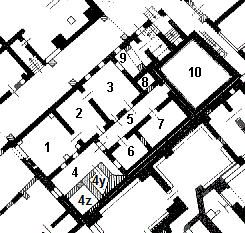 Plan of the building. After SO I. |


