

GOLD GLASS
In July 2009 I received an email message from Anne Mader, living in the USA:
"I am wondering if gilded glass has been found in any of the Ostia excavations, particularly during the time of Pope Pius IX? The reason I ask is that my family has recently inherited a piece of gilded glass. There is a note with the glass that states it was given to my great great grandfather Sir Admiral Thomas Cochrane in 1864 during a private interview with Pope Pius IX. There is no other information about this piece and my family is not sure why it was given to Thomas Cochrane except that he was a well known Naval officer and we understand that Pope Pius IX was doing excavations in Ostia at this time. There are political undertones that connect the two but I am unable to find a direct link" ... "I have been looking at the glass and I can't see a "motto" - there is possibly something on the right side in gold within the inner circle but it does not appear to be very clear. However, the more I look at it in the picture the more it looks as if there is something there - or it could be my eyes making something of nothing".
These are the photos I received (click on the images to enlarge them):
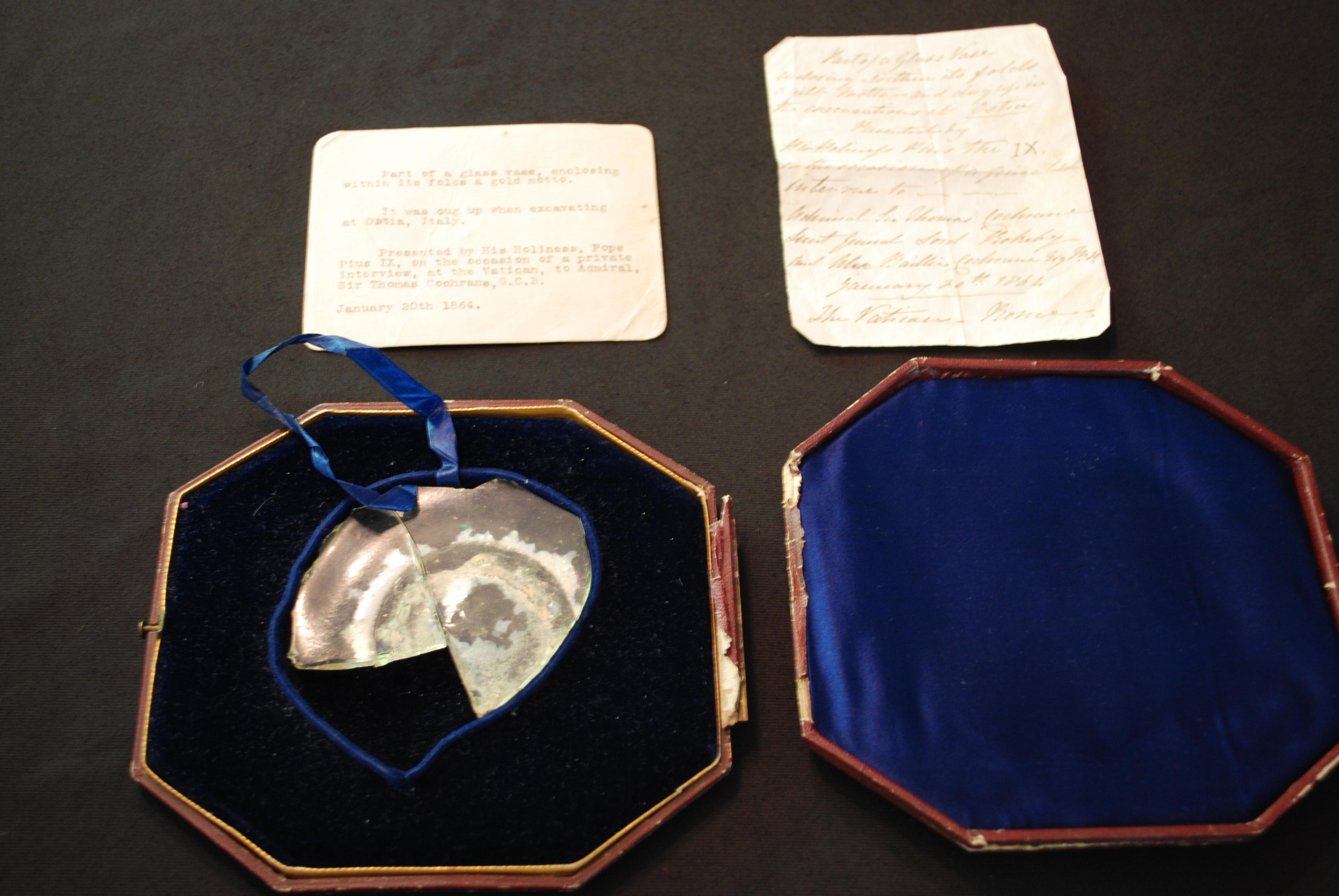
Ensemble with typewritten note.
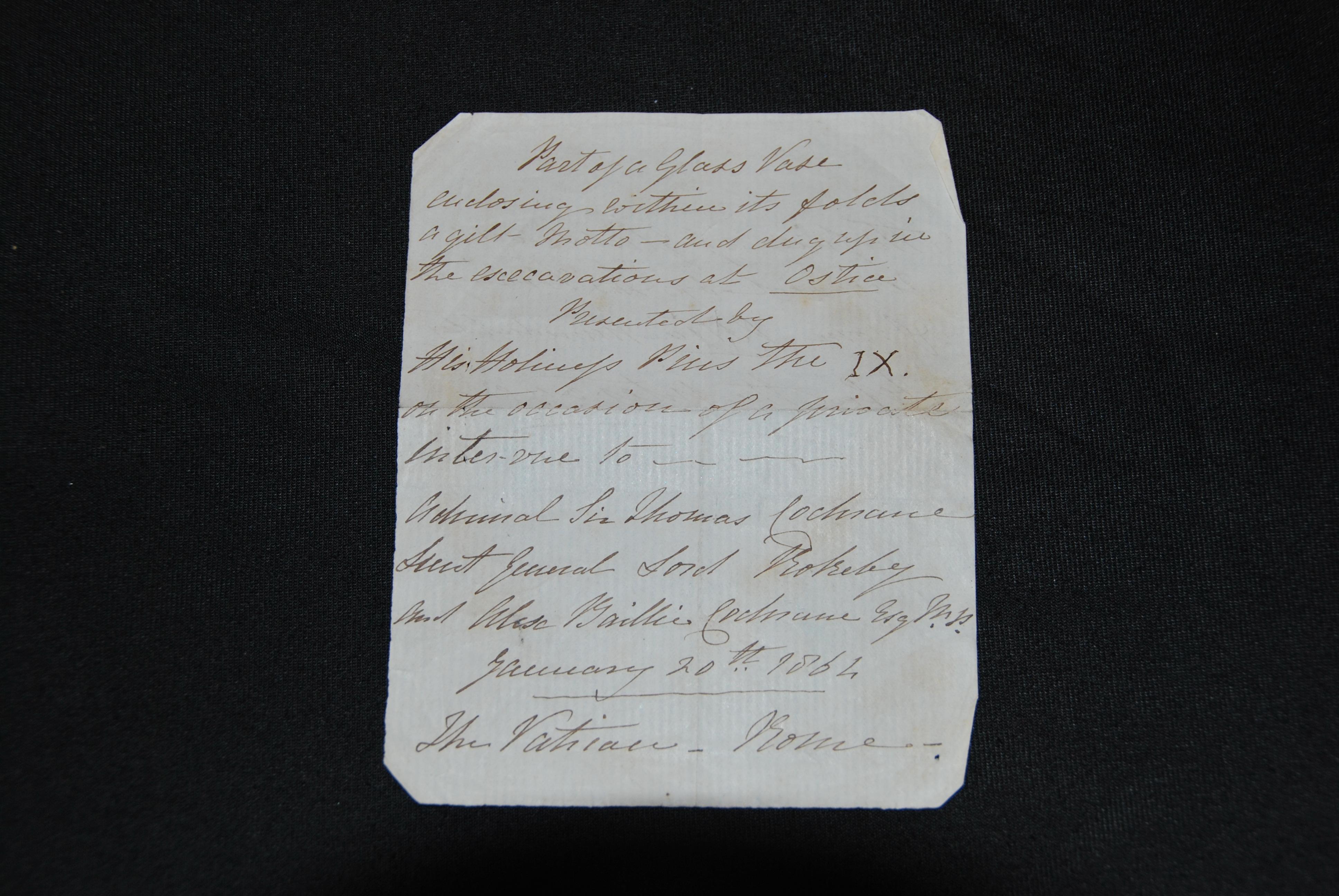
Front of written note.
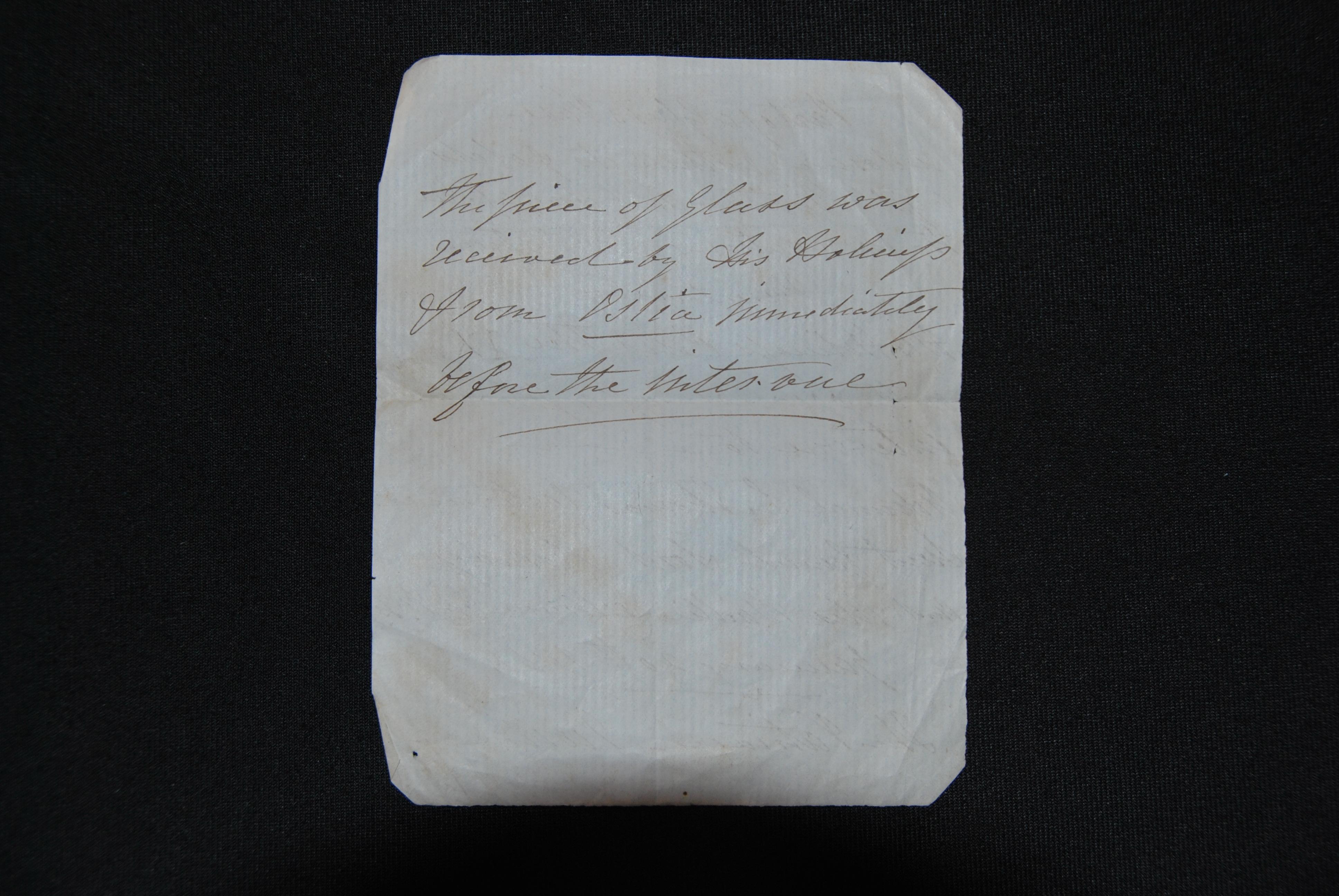
Back of written note.
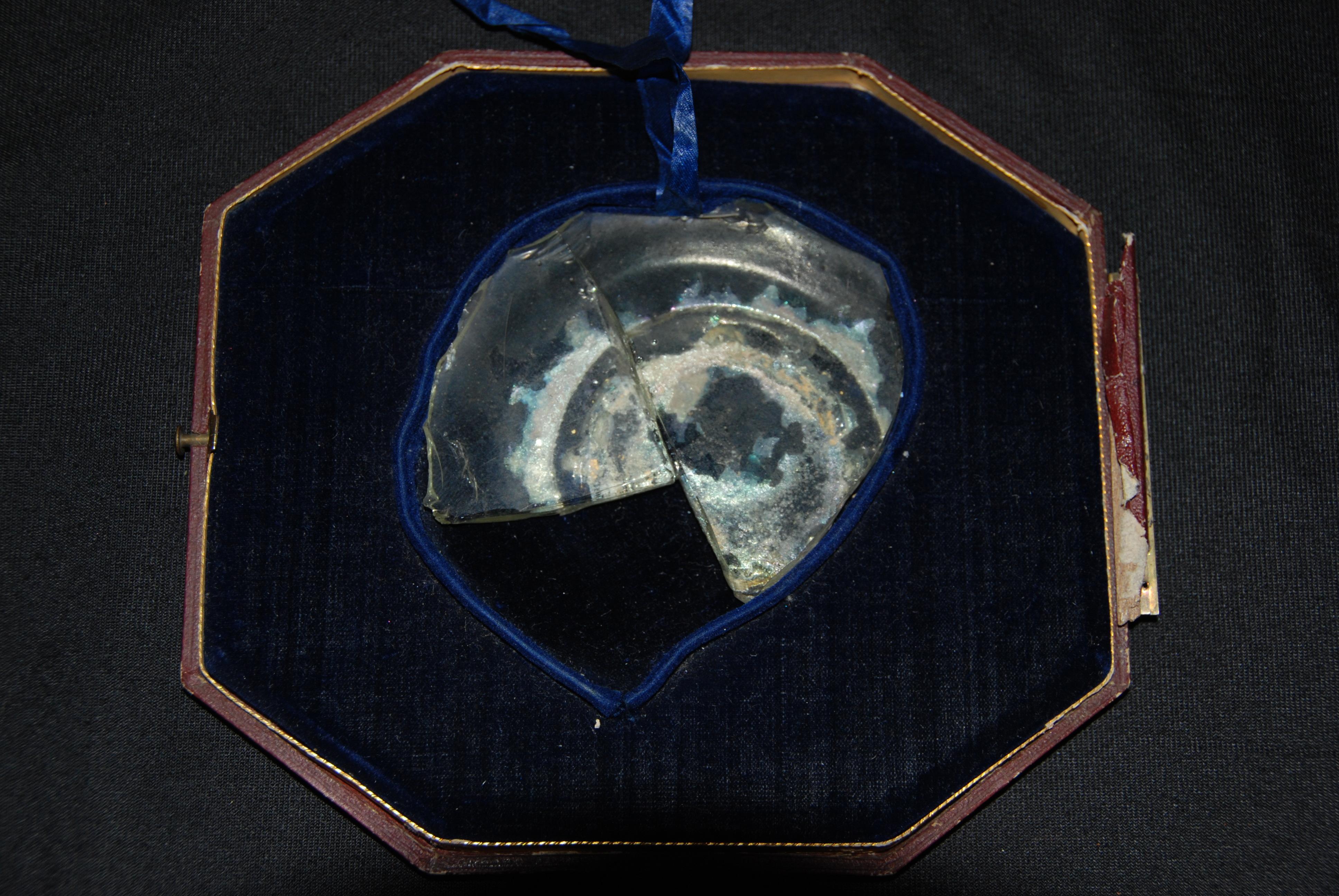
Glass in case.
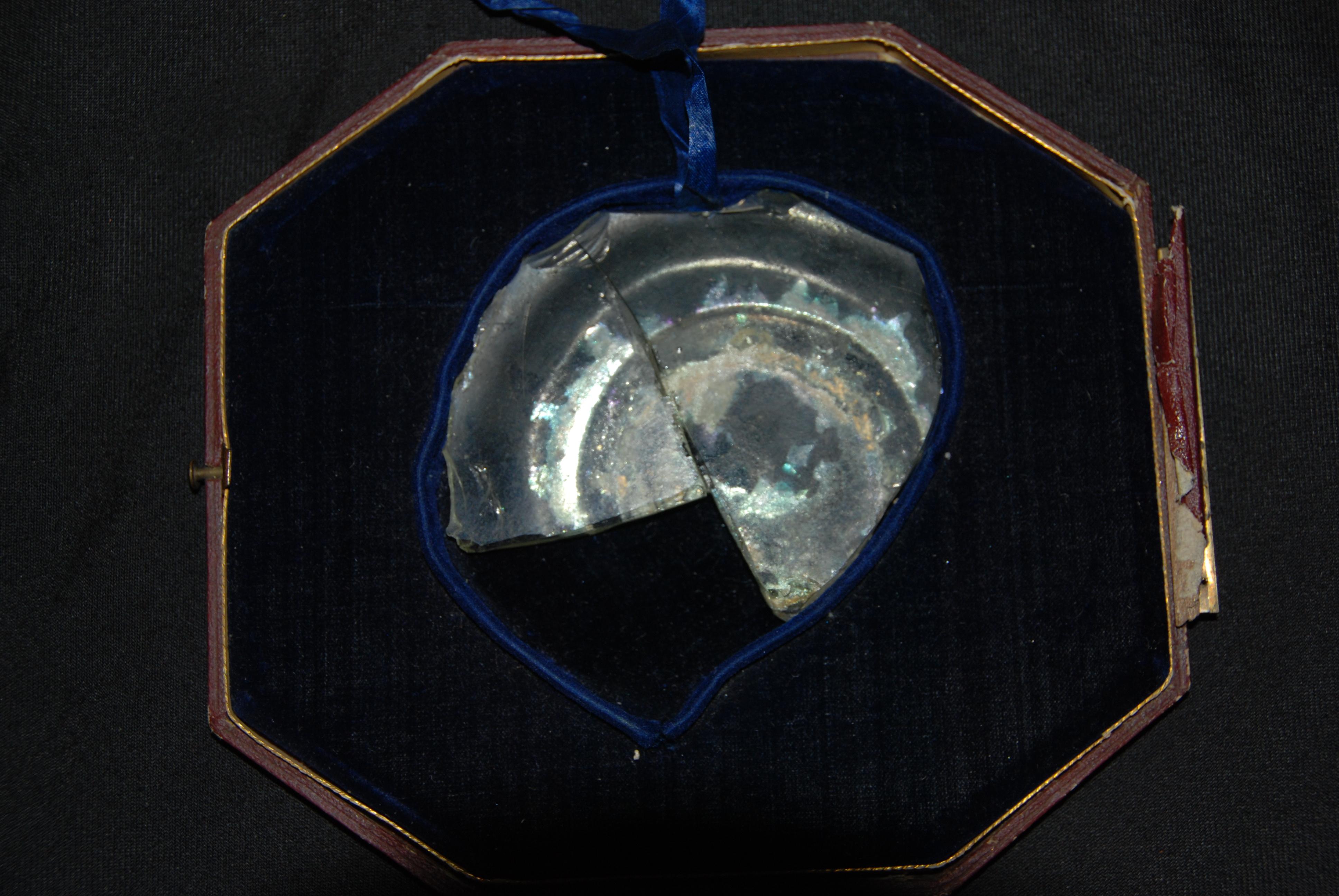
Glass in case, second photo.
The glass is kept in a shallow octagonal case, perhaps of leather, inside which is cloth. Two glass sherds are surrounded by a blue ribbon, a third sherd is obviously missing. Above the sherds we see a typewritten note with the text:
Part of a glass vase, enclosing
within its folds a gold motto.
It was dug up when excavating
at Ostia, Italy.
Presented by His Holiness, Pope
Pius IX, on the occasion of a private
interview, at the Vatican, to Admiral,
Sir Thomas Cochrane, G.C.B.
January 20th 1864.
This is a partial copy of another, handwritten note. Here we read:
Part of a Glass Vase
enclosing within its folds
a gilt motto - and dug up in
the excavations at Ostia
Presented by
His Holiness Pius the IX.
on the occasion of a private
intervue to - - - - - -
Admiral Sir Thomas Cochrane
Lieut(enant) General Lord Rokeby
And Alex Baillie Cochrane Esq(uire) M(ember of) P(arliament)
January 20th 1864
The Vatican - Rome.
The back of this note can be seen on the photograps as well. Here we read:
The piece of glass was
Received by His Holiness
from Ostia immediately
before the intervue
We obviously have two stories here, that of Thomas Cochrane and that of the glass. Let us begin with the Admiral.
Anne informed us that her ancestor is Admiral Thomas John Cochrane, born on February 5 1789, passed away on October 19 1872. More information about him can be found at ThePeerage.com and in Wikipedia. More information about Anne is also at ThePeerage.com. Cochrane was, as the note states, Admiral and GCB, that is, he had the Grand Cross in the Order of the Bath. There is a slight problem here however. He became an admiral in 1865, one year after the glass was given. However, if the note was written later than 1864, then the information provided may also be later than 1864.
A book written by Stephen Watson Fullom, Rome under Pius IX, helps us a bit further. He had visited Rome, and afterwards finished his book in July 1864 (see the introduction of the book, page v). Fullom attacks the Roman Catholic clergy, but is not hostile to the Pope. Political prisoners seem to have been an issue. On page 88 he describes a visit to a prison that he made together with Henry G. Wreford, correspondent of The Times, Sir Thomas Cochrane, Mr. Baillie Cochrane M.P., and Monsignor Talbot. The name Baillie Cochrane is also written on the note. He was the son of the admiral. More information about him is in Wikipedia. Lord Rokeby, found on the note but not mentioned by Fullom, also has a page in Wikipedia. Information about Henry Wreford is provided by the Dickens Journal Online.
Then the gold glass. A motto is mentioned in the note, but it cannot be read on the sherds. The sherds must have come from either Ostia or its harbour district Portus, because of the ongoing excavations there. Until 1870 Ostia was property of the Papal State. Pius IX ordered excavations that took place between 1855 and 1870. He visited Ostia several times and there is a photograph of his visit in 1866. In the same period Portus, the harbour district, was property of the Torlonia family (part of it still is), a very wealthy family of bankers. This family carried out excavations between 1863 and 1869. Most of the finds were taken to the Museo Torlonia in Rome, but Christian objects and objects from Christian buildings were given to the Vatican.
Ludovico Paschetto concluded from an entry in the Giornale di Roma, 9 March 1864, that in January-February of that year excavations took place in Ostia "on the other side of the square at the entrance of the city", "in a noble house", perhaps near the Porta Romana he adds. Reported finds: "Various small objects, one of which was a communal drinking glass with the acclamation "maxime dulcis z(esei)", which was perfectly preserved and had a very well written text" (Paschetto 1912, 552-553, nr. 429). Could Anne's sherds belong to this vessel?
The find is mentioned by G.B. de Rossi in the Bullettino di Archeologia Cristiana 1864,5, p. 40. De Rossi states that the find was made by Pietro Ercole Visconti near tombs in which Christian funerary inscriptions were found. Paschetto has suggested (with a question mark) that the vessel was found near the Porta Romana, which would lead us to the so-called Porta Romana necropolis. However, in the 1860's Pietro Ercole Visconti was excavating tombs to the south of Ostia, today known as the Porta Laurentina necropolis.
The text "maxime dulcis z" is mentioned in H. Volpel, Die altchristlichen Goldgläser, Freiburg 1899. On p. 96 at nr. 14 (no illustration available) he states that it was found in 1864 in Ostia and is now in the Gregorian museum. He mentions the text in a section with inscriptions called "Lateinisch mit Eigennamen", in other words, he regards "maxime" as the name of person. It is the vocative of the name Maximus, and the translation is: "Sweet Maximus, may you live" (in paradise).
The text is also mentioned in the Corpus Inscriptionum Latinarum XV,II,1 by H. Dressel. He reads "z(eses)" instead of "z(esei)". He adds: "In fundo vasculi rep. a. 1864 Ostiae prope Mithraeum, litteris aureis, Mus. Vatican. Gregorian. Inscriptum coronae gilvo colore pictae. Descripsi a. 1894". That is: "On the bottom of a vessel found in 1864 in Ostia near a mithraeum, with gold letters, in the Vatican Gregorian Museum, with the depiction of a pale-yellow crown. I made the description in 1894". The mithraeum mentioned by Dressel is most likely the Mithraeum of the Animals, not far away from the Porta Laurentina necropolis, and excavated by Carlo Ludovico Visconti (nephew of Pietro Ercole) in 1867.
The text "maxime dulcis z(esei)" is not mentioned in C.R. Morey, The Gold-Glass collection of the Vatican library with Additional Catalogue of the Other Gold-Glass Collections, Vatican City 1959. This is a very complete catalogue of the Roman gold-glass in museums in many countries. Perhaps the sherd was not accessible in 1959. Objects from Ostia were taken to the Museo Lateranense that was housed in the Lateran Palace. It was integrated with the Vatican Museums (moved to Vatican City) as Museo Gregoriano Profano in the years 1958-1963 by order of Pope John XXIII. The collection was reopened in 1970. So the collection was being transferred in the period when Morey studied and published the gold-glass.
Dressel also states that the text is "on the bottom of a vessel". What Anne has is also a bottom, but without a motto. It seems therefore that we are talking about two different objects. We know this about the bottom of glass vessels: "The early Christians in Rome buried their dead in subterranean galleries or catacombs, sometimes in burial chambers but more often in niches or loculi along the narrow corridors. It was customary after burial to seal the tomb and frequently there were impressed in the moist plaster or cement, fragments of gold glass which had originally formed the bottoms of drinking vessels" (C.L. Avery, "Early Christian Gold Glass", The Metropolitan Museum of Art Bulletin 16,8 (1921), 170-175). Designs in gold leaf were enclosed between two layers of glass. That explains the words "holds within its folds" on the note.
It seems that in early 1864 Pietro Ercole Visconti found two glass bottoms belonging to Christian tombs. He presented them to the pope, who kept the one with the text "maxime dulcis z", and gave another one to his English visitors. Perhaps Anne's sherds also had a motto, now disappeared. More likely, her ancestor received a sherd of the kind that may have a motto.